Tuesday, May 10, 2011

Final Solutions


My finals solution consists of a Muni campaign, more specifically posters that will be both at bus stops and on the bus itself. The vertical poster is marketed toward students, and the horizontal marketed toward parents.

Saturday, April 9, 2011

10 Lessons that Art Teaches

1. The arts teach children to make good judgments about qualitative relationships.
Unlike much of the curriculum in which correct answers and rules prevail, in the arts, it is judgment rather than rules that prevail.

2. The arts teach children that problems can have more than one solution
and that questions can have more than one answer.

3. The arts celebrate multiple perspectives.
One of their large lessons is that there are many ways to see and interpret the world.

4. The arts teach children that in complex forms of problem solving
purposes are seldom fixed, but change with circumstance and opportunity. Learning in the arts requires the ability and a willingness to surrender to the unanticipated possibilities of the work as it unfolds.

5. The arts make vivid the fact that neither words in their literal form nor numbers exhaust what we can know. The limits of our language do not define the limits of our cognition.

6. The arts teach students that small differences can have large effects.
The arts traffic in subtleties.

7. The arts teach students to think through and within a material.
All art forms employ some means through which images become real.

8. The arts help children learn to say what cannot be said.
When children are invited to disclose what a work of art helps them feel, they must reach into their poetic capacities to find the words that will do the job.

9. The arts enable us to have experience we can have from no other source
and through such experience to discover the range and variety of what we are capable of feeling.

10. The arts' position in the school curriculum symbolizes to the young
what adults believe is important.


SOURCE: Eisner, E. (2002). The Arts and the Creation of Mind, In Chapter 4, What the Arts Teach and How It Shows. (pp. 70-92). Yale University Press. Available from NAEA Publications. NAEA grants reprint permission for this excerpt from Ten Lessons with proper acknowledgment of its source and NAEA.
“…art training is not one of the minor fillers of the curriculum, but relates to the very fundamentals of education. What are these fundamentals? Reading, writing, and arithmetic? Certainly these are indispensable skills; but should we not realize by now that they are just skills? And that even as a list of skills the list is incomplete? If I am not mistaken, the three fundamentals of education are
Perceiving
Thinking
Forming
And the tools needed to exert these faculties of the mind are numbers, words, and shapes. Of these three sets of tools the first two have been considered the only essential ones since the Middle Ages. We must now rehabilitate the third.”


Rudolph Arnheim, “Perceiving, Thinking, Forming,” Art Education Magazine, March 1983

Thursday, March 24, 2011

Saturday, March 19, 2011

Progressive San Francisco Schools

The Urban School of San Francisco (9-12)
The Urban School of San Francisco seeks to ignite a passion for learning, inspiring its students to become self-motivated, enthusiastic participants in their education – both in high school and beyond.

The Discovery Center School (K-12)
At DCS, we believe education is more than just an accumulation of facts. We serve our students as the sensitive, intelligent, creative beings they are. We believe the purpose of our school is to provide a safe and supportive learning environment so that our students may nurture and develop the unique excellence within each of them.
Founded by an SF State Professor, Dr. Patrick A. O'Donnell.

Drew College Preparatory School (9-12)
Drew students take part in integrative, hands-on, and experiential learning to connect what happens in the classroom with the world beyond our doors. Drew gives students an education for life.

San Francisco School of the Arts (9-12)
Aims to provide a program of instruction in which content from the arts is integrated into traditional non-arts subject areas and includes attention to multi-cultural arts.

Examples of Progressive Learning/Teaching Techniques

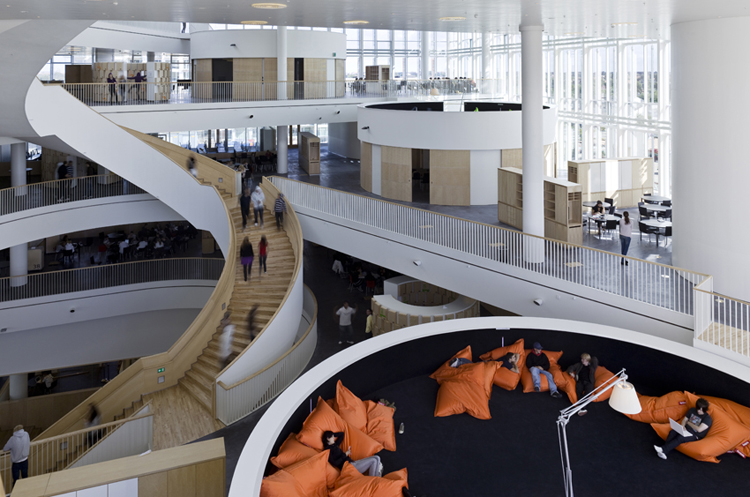
Orestad College in Denmark
Eliminated the classroom space to encourage collaborative learning.


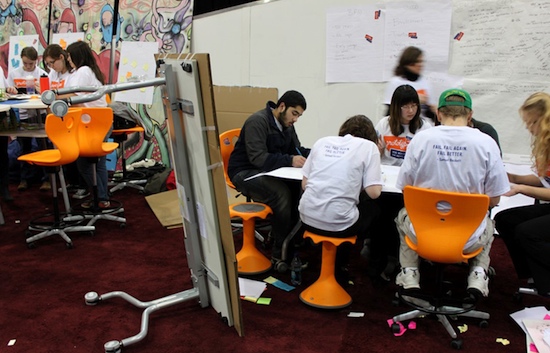
Prototype Design Camp
A K-12, 3-day camp with participants from 14 different schools. Located in Ohio.


Henry Ford Academy in Detroit
Self-contained classrooms are replaced with clustered learning spaces. The relationship of the spaces is designed to accommodate multiple modes of teaching and learning.


Lifelong Kindrgarten Lab
In this interview, Mitchell Resnick from MIT characterizes the Lifelong Kindergarten Lab in the new Media Lab building.


Denver School of Science and Technology
Operates under the STEM philosophy (See Obama's plan to revamp the No Child Left Behind Act here).